
The Spaghetti Squirrel Theory of Marketing
The marketing funnel, which has powered basically the entire marketing & advertising industry for like 100 years, is wrong. Well, not “wrong” per se, but it’s incomplete.
The marketing funnel is, quite literally, shaped like a funnel… and it looks that way for a reason. It describes how a buyer moves through their journey from identifying a problem they want solved (I need a new dishwasher, what’s the best sleeping bag, which custom software developer should I hire, whatever), to becoming aware of their options, to considering solution providers, to choosing one, to a buying decision. And for most of the 20th century it was honestly pretty accurate… information was scarce, options were limited, and buyers mostly moved in one direction.
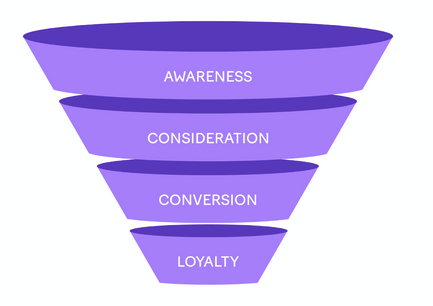
So, the entire marketing and advertising industry was built on that funnel — how do we move buyers through the funnel as quickly (and often) as possible? But buyer behavior fundamentally shifted with the onset of the internet, and I fear too few companies understand HOW it changed… and what it means for them.
So how do you navigate what Google calls “the messy middle” to convert your prospects into buyers?
The Messy Middle
As with most early technologies, we’re often creating digital versions of analog assets in the beginning. A modern résumé is just a digital representation (read: .pdf) of a physical document… it’s not a whole new thing to better determine a person’s fit for a job. So, you’d be forgiven for thinking that the internet might have just added more stops on the same funnel-shaped path as we digitized a seemingly inherent human habit. But that’s not what ended up happening… the Internet fundamentally changed the nature of the buyer’s journey.
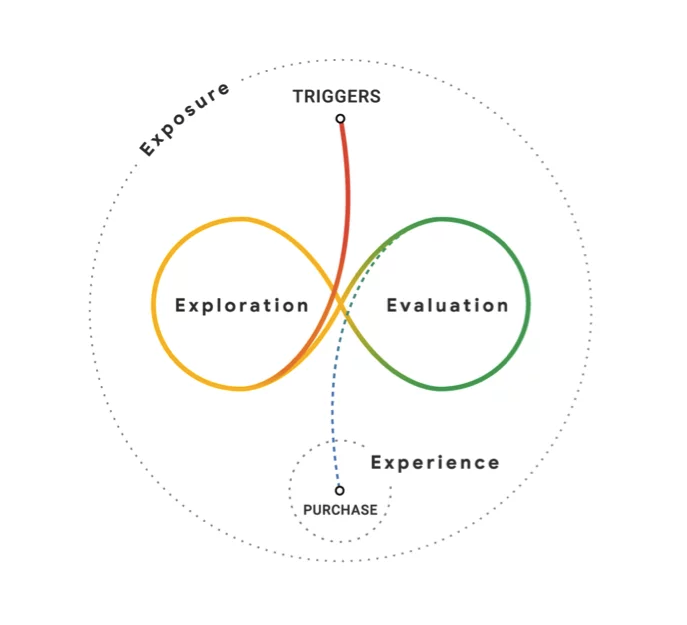
Google watched hundreds of buyer journeys across 31 categories and found no typical paths. The visualization they used looked like cooked spaghetti on a plate. People switching products mid-search, looping back to the beginning after getting close to a decision, opening eight browser tabs and closing seven of them. One buyer journey looked nothing like another, even within the same category, even for the same type of product.
The funnel assumes a linear handoff → awareness passes to consideration passes to decision. The messy middle research shows that "exploration" and "evaluation" aren't sequential stages, they happen at the same time, continuously, until something kicks them out of evaluation and exploration into the buy decision. The funnel has no language for that because the process is no longer funnel-shaped at all.
Navigating Spaghetti
My gut tells me the primary reason the Internet broke the tidy funnel is this: the funnel requires information and/or options scarcity. If you’re limited by options, devoid of information, constrained by geography, whatever… then it makes sense that you’d move through a funnel linearly and orderly. But the Internet upended that because information was now ubiquitous, and it was free.
The downside of all that information was… you guessed it… information overload. There’s now a surplus of information related to any particular buying decision, which reinforces that spaghetti loop behavior in the “exploration/evaluation” messy middle. The loop can (and does) run as many times as needed… and the consumer controls the exit, not the brand.
So what makes someone stop looping? You’d think it was more information, but we’ve already established more information is actually a spaghetti reinforcement. The word you’re looking for here is confidence.
People don’t get stuck because they can't find information, but because they haven't accumulated enough confidence to commit.
In his 2019 book “Alchemy”, Rory Sutherland references a theory attributed to former Ogilvy & Mather ad executive Joel Raphaelson. The theory states that “people do not choose Brand A over Brand B because they think Brand A is better, but because they are more certain that it is good.”
The question isn't "where are our buyers in the funnel?" but rather "what's making them uncertain, and are we anywhere near them when they're trying to resolve it?".
Your job as a company stops being about proving you’re the best option in the category; instead, it becomes reducing the uncertainty a buyer feels about choosing you.
It’s a different end goal, and it calls for different work from marketers.
The Plate Corollary
That’s not where the spaghetti ends though… there’s an always-on backdrop Google calls "exposure." It’s the sum total of everything a person has ever heard, seen, read, or felt about a brand, its competitors, and the market set they exist within. Don’t think about it like a stage… it's more like ambient environment or background radiation.
For purposes of the spaghetti analogy, I like to think of it as the plate. Regardless of what your potential buyers consume of the spaghetti, the plate remains. It's why a company can win or lose before a person even enters the loop. Your exposure level is either building or eroding constantly, whether you're running campaigns or not. Brands that have spent years producing trustworthy, useful content waltz into a buyer's consideration set with a head start that's genuinely hard to purchase.
Before a buyer can choose you, you have to be on the plate where they’re twirling their metaphorical spaghetti.
The Trust Mechanics
So what triggers that switch from uncertainty to confidence? The first is social proof: referrals, public reviews, youtube reviews, the things you can’t really control unless you resort to unscrupulous methods.
The second most commonly powerful, though? Authority bias. Do you appear as authoritative, credible and trustworthy in the marketplace of ideas?
Google attributes this more to like, journalists or industry experts endorsing your product or brand. That is absolutely true, but I think it’s an incomplete mental model of authority bias. Yes, academic or expert citations can certainly help your brand, but it’s also (and I hate that I’m about to write this), a vibe.
Do potential buyers feel like you know what you’re talking about?
Do you seem to truly understand their problem?
Do you seem capable enough to actually solve it?
And, perhaps most crucially, do you seem like the type of person they’d want to do business with?
The research is explicit that social proof has to be earned over time as consumers experience a product or service. You can't manufacture it with a media buy. Authority bias works the same way in my opinion.
You have to produce content that provides value to potential buyers, consistently, over a long time horizon. You’re adding positive tics on the plate of exposure. So when that fat stack of spaghetti lands on the plate, you’re already in the conversation with good vibes associated with you and your brand.
The Squirrel Theory of Spaghetti
So now it’s time to torture our spaghetti/plate metaphor a step further with some squirrels. It’s getting weird in here, but bear with me (see what I did there?).
How people search for information in the spaghetti stage is incredibly important for how you try to show up on the plate. Google called this “foraging behavior.”
Much like squirrels, humans forage for information when they’re in the spaghetti phase. During exploration, they search for "ideas," "best [category]," "difference between X and Y." Less than 5% of those searches include a brand name. They weren't searching for you; they were trying to figure out what to want.
Put another way, 95% of people don’t begin a purchase journey with a brand preference. They have a specific question they want answered, so they forage for information to help answer it. It’s not like a lion hunting a gazelle — one, specific end goal in mind, and you pursue that end goal with ruthlessness. Instead, it’s more akin to squirrels wandering around foraging for acorns on the ground.
The brands who are already out there answering buyers’ question(s) with authority, credibility, authenticity, and trustworthiness are the acorns on the ground. You can’t guarantee a particular squirrel will pick you, but you are in the consideration set.
The brands with no useful presence in those moments don't just lose out on a sale… they never even entered the conversation that preceded one. No acorns whatsoever.
What shows up in those foraging searches is organic content: articles, category explainers, comparison guides, walkthroughs from people who've actually used the thing. A banner ad doesn't answer "what's the difference between X and Y." But a useful piece of writing or social video that genuinely helps someone navigate a category decision? Those do. And every time that piece surfaces in a feed, it's another small accumulation of the exposure that either puts a brand in the loop or boxes it out.
These buyers aren’t looking for a brand to sell to them, they're looking for something to help them understand.
The brand that provides that understanding earns an acorn on the ground or a place on the plate.
The Ads Aside
There's a version of this argument that slides into "stop running ads," which isn't what I'm saying and isn't what the research says either. Paid advertising is good at showing up at specific moments in the loop and applying cognitive shortcuts that genuinely work (scarcity, social proof at volume, certain anchoring effects… and the research has interesting stuff on how ads that hit multiple shortcuts simultaneously dramatically outperform single-trigger executions).
What I'm pointing to is more specific: the two levers that dominate a buying decision are things you accumulate through experience and presence. You can supplement them with paid, but you can't substitute for them.
Ads cannot build genuine authority. They cannot create the ambient exposure that accrues from being a trustworthy presence across the full span of the explore/evaluate spaghetti loop. The research shows social proof and authority are the two biggest purchase levers… and they're both things you earn through content and experience, not things you buy with impressions.
There's also a footnote in the research on something called the “mere exposure effect”. It’s the idea that repeated neutral-to-positive encounters with a brand build affinity over time, independent of whether someone is in a buying cycle. That reads to me as an argument for consistent, useful presence rather than for maximizing how often you interrupt someone who wasn't thinking about you.
Making the Spaghetti Work For You
The question "how do I market to buyers" is the wrong frame if buyers are spending most of their decision-making time in a loop that doesn't look like marketing. The right question is "how do I become a trusted resource that people encounter and return to while they're trying to figure out what to buy?"
The answer the research points to is authentic, credible, authoritative organic content. That’s not because it's inherently virtuous, but rather because it's the only thing that can show up at the exploration stage (where brand preferences get formed), accumulate the trust signals that matter most (social proof, authority), and build the ambient exposure that influences the loop before and after a trigger fires.
According to Google’s own research, the brands that win in the messy middle aren't the ones with the biggest ad budgets. They were the ones that had been a credible, useful presence long enough that buyers encountered them during the loop and accumulated — borrowing the Raphaelson word — enough certainty that they were good.
Put another way, the winners amongst the spaghetti squirrels are the brands that understand that the job of marketing shifted from interrupting attention to earning it.
That shift has a name: trust. And trust, it turns out, scales.